
Table of Contents
In the same way, the stone R is so opposed to the quantity (exactly equal in size) of air-aether above it.
The stone would occupy the place of that air-aether if R moved farther away from center T.
- That air-aether would necessarily have to descend to the extent that the stone rose.
That stone would then be opposed to an equal quantity of air-aether below it.
- That air-aether would have to rise back the closer it gets to the center
T. - This would then force the stone to descend.
The stone has no force to rise above the air-aether in the planetary gravitational territory because:
- The stone has much more earth-aether than an equally sized air-aether has earth-aether.
- To counterbalance this, the stone has less air-aether
- The stone’s earth-aether is less agitated by the air-aether around it.
Instead, the air-aether around the stone has the force to make the stone fall by moving it towards the center T.
Thus, the small amount of air-aether in the stone is light compared to the earth-aether in the stone.
-
But when compared to pure air-aether, it is heavy
-
Consequently, it contains much less of the air-aether.
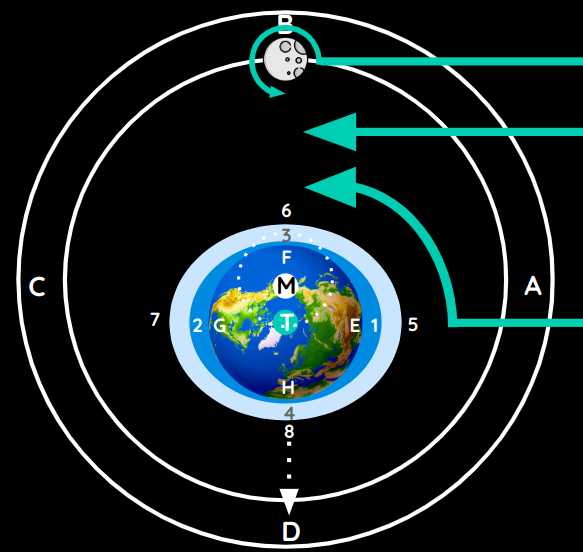
Thus, each part of terrestrial bodies is pressed toward T.
Each body is pushed differently by the surrounding air-aether according to the quantity of the earth-aether that it has.
- This push depends on the amount of air-aether beneath an earth-aether that can take its place as the earth-aether goes down.
“Homogeneous” bodies are those that act as one. Examples are physical air and water.
This is why:
- the gravitational force of the air-aether is not noticably more in the deepest valleys than in the highest mountains.
- a man in very deep water does not feel it weigh on his back any more than if he were swimming right on top.[52]
Why Don’t We Spin Off the Earth?
Why doesn’t the stone fall to the east 6 or west 7?
This is because all the terrestrial parts in the circle 5678 is being pressed toward T by the air-aether as one mass.
The parts of the stellar air aether have very irregular and diverse shapes.
- These must join together and compose only one mass, which is borne as a whole by the territory
ABCD - This is why, while the whole territory
ABCDturns, the air-aether at6always remains opposite to those that are at2and atF. - They only shift one way or the other due to physical winds or other forces.
The air-aether at ABCD rotates much faster than the Earth.
- But its air-aether that are caught in the pores of terrestrial bodies move just as slow as those terrestrial bodies around the center
T
The air-aether pushes the stone R to center T because the air-aether tends to move away from the center with more force than the stone.
- Yet the air-aether cannot force the stone to back up toward the West or East because it moves vertically in a straight line.
This downward force of the air-aether on the stone R cannot make it fall towards the West or East. This is because it focuses all its effort to make the stone move towards T according to the earth-aether contained in the stone relative to the air-aether that it has.
The stone travels in the same speed whether towards the East or West because the stellar-air-aether around the stone applies its force both on the air-aether and earth-aether there [as a unit, regardless of lateral direction].
Many philosophers say that:
- if the Earth rotates then things would fall not in a straight line
- cannonballs fired towards the West should travel much farther than if pointed towards the East
- we should always feel great winds in the air and hear great noises [in the East]
This is because they do not know that the rotation of the Earth is carried by its gravitational territory.
Such arguments do not affect the motions that I am describing here.
Leave a Comment
Thank you for your comment!
It will appear after review.